
CODY JINKS & ALICE COOPER - "Moving Mountains" - Late August Records
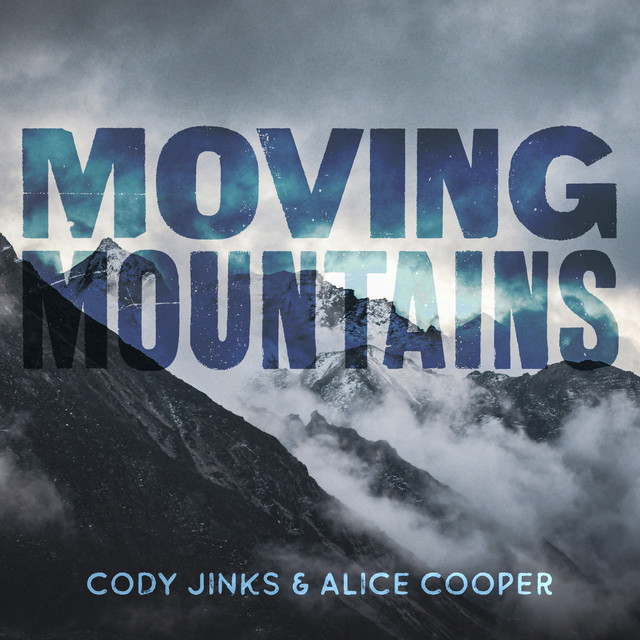
Some collaborations make sense immediately. Others become compelling because the distance between the artists makes the meeting so unexpected. “Moving Mountains,” the new collaboration from Cody Jinks and Alice Cooper, belongs to the latter category. Bringing together Jinks’ independent country sensibility and Cooper’s unmistakable rock identity, the song finds common ground in faith, perseverance and the challenge of confronting whatever stands in the way.
Released October 2, 2026, through Jinks’ Late August Records, “Moving Mountains” was written by Jinks, Cooper and legendary producer Bob Ezrin. The song occupies an intriguing space between country, rock and faith-centered songwriting, resisting the need to choose one lane. That genre fluidity feels less like a stylistic experiment than a natural extension of the song’s subject matter, which considers life as a journey and the importance of being prepared for what comes next.
The collaboration itself began with Jinks. He started writing the song in Hawaii and completed it in Colorado during pre-production with his band. As the track developed, its sound began leaning more toward rock than traditional country, prompting Jinks to send a rough demo to Cooper. Cooper quickly agreed to contribute, recognizing something familiar in Jinks’ independent approach.
That shared outsider mentality gives the collaboration its credibility. Cooper has praised Jinks as an uncompromising songwriter with an edge, while Jinks has called the resulting partnership one of the coolest collaborations of his career. Those perspectives help explain why the pairing works: neither artist is being asked to abandon his identity to meet the other halfway.
Instead, “Moving Mountains” lets their respective strengths coexist. Jinks brings grounded storytelling and the hard-earned perspective of a songwriter rooted in country music, while Cooper adds the unmistakable authority of a performer whose voice has carried rock songs across generations. The contrast between them becomes part of the song’s appeal, giving the collaboration a character that neither voice would create alone.
The song’s central metaphor is particularly effective. Packing for a long tour becomes a way of considering spiritual readiness for a journey from which there is no return. It is a striking image, but the writing gives it room to mean more than one thing. The suitcase, the road and the preparations become reminders that life is temporary and that the choices made along the way matter.
That idea connects naturally to the song’s themes of faith and perseverance. “Moving Mountains” does not suggest that every obstacle can simply be wished away. Instead, it considers the strength required to keep moving forward while recognizing that some of life’s biggest challenges demand something deeper than determination alone. Its spiritual perspective gives the song gravity without limiting its meaning to a single interpretation.
The song was written without a specific genre in mind, and that freedom ultimately works in its favor. Its country roots provide an intimate storytelling foundation, its rock identity gives the collaboration muscle, and its faith-centered perspective gives the material a larger sense of purpose. The result feels cohesive without being easily categorized.
The track was accompanied by an official music video and serviced across country, rock and Christian Contemporary radio formats, an unusually broad rollout that matches the song’s musical reach. Yet the recording itself remains the focus. It does not sound engineered to satisfy three different audiences; it sounds like two artists meeting on material they genuinely believe in.
“Moving Mountains” succeeds because the collaboration never feels like a stunt. Jinks and Cooper arrive from different musical worlds, but both understand the value of conviction, strong songwriting and artistic independence.
What emerges is more than an unexpected duet. “Moving Mountains” is a thoughtful meeting of country storytelling and rock authority, using a deceptively simple image of the road to ask a much larger question: when the journey finally ends, will we be ready for where it leads?
(Review Written By: Chad Carlson)
Latest Updates
- Single Review: Cody Jinks & Alice Cooper - “Moving Mountains”
- Single Review: Clay Walker - “All Wrapped Up In You”
- Single Review: Hardy - “The Man In The Box”
- Single Review: Bayker Blankenship - “Make Trouble”
- Single Review: Brendan Walter - "Model Maniac"
- #throwbackthursday: Blake Shelton - "The Baby"
- Single Review: Cigarettes @ Sunset - "Carolina Shakedown"
- Music Video: Vincent Mason - "Damned If I Do"
- Visualizer: Joe Nichols - "Say La V"
- Music Video: Shinedown - "Searchlight"
- Lyric Video: Miranda Lambert & Ella Langley - "Snakeskin Boots"
- Lyric Video: Noeline Hofmann - "Wilson Silverstar 402 Blues"
- Visualizer: Erin Kirby - "Cross My Mind"
- Single Review: Jacob Hackworth - "Last Night I Got Lonely"
- Single Review: Myles Morgan - "Missin’ Me Drunk"
- Lyric Video: Stella Lefty & Vincent Mason - "Something To Lose"
- #throwbackthursday: Kenny Chesney - "Don't Blink"
- Single Review: Kaitlin Butts - “What More Could You Want”
- Single Review: Mitchell Tenpenny - “Ain’t My Problem”
- Single Review: Walker Montgomery - “24/7 365”