Tim McGraw
Saturday, September 19, 2026
@ Credit Union 1 Amphitheatre in Tinley Park, IL
(Review Written By: Dave Pierce)
(Photo Credit: Zach Pierce)
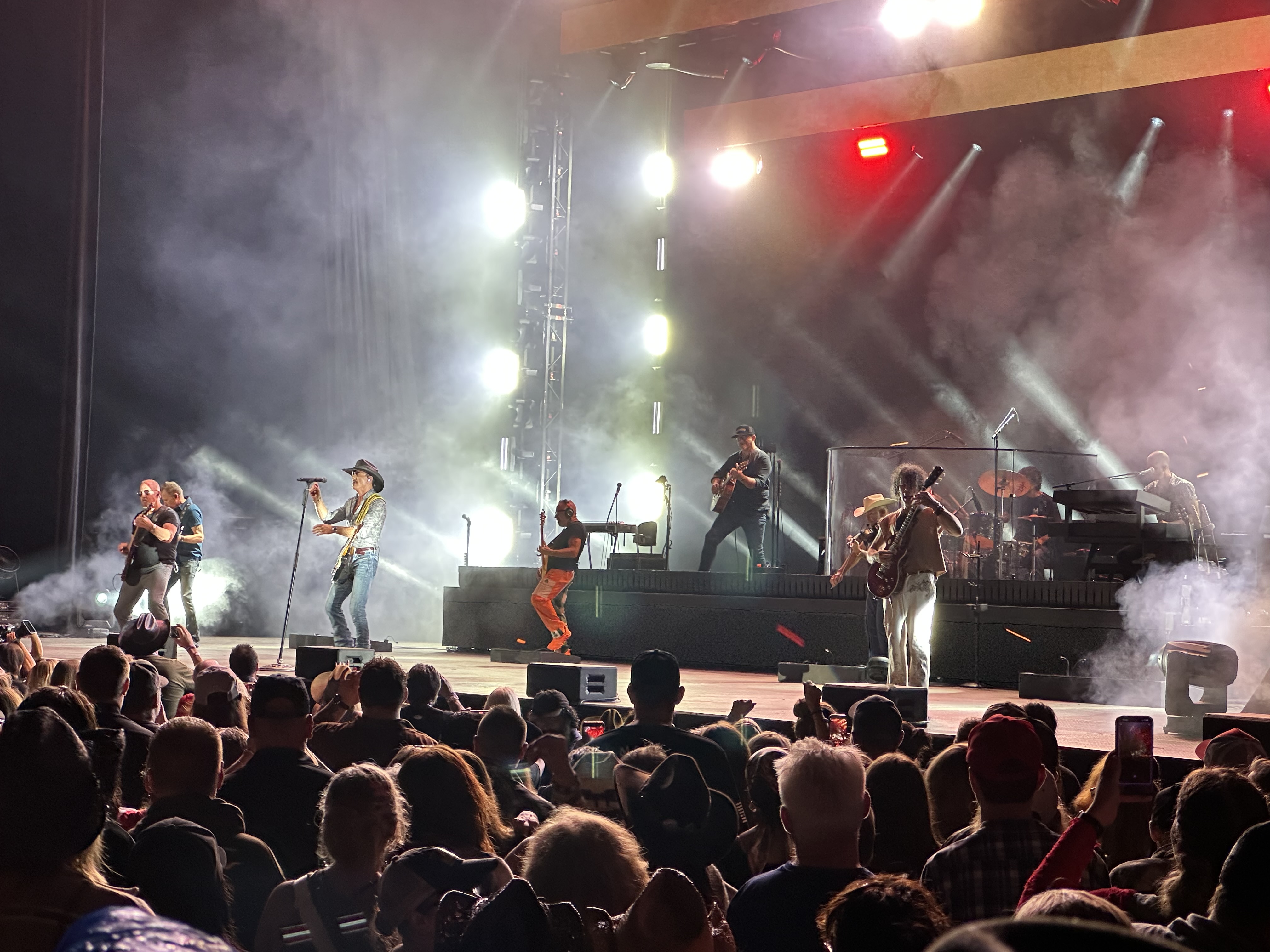
Tim McGraw’s 2026 North American Pawn Shop Guitar Tour, promoted by Live Nation, arrived in Tinley Park as a late-summer headline stop at Credit Union 1 Amphitheatre, bringing with it the promise of a country star working from both a new chapter and three decades of radio-deep familiarity. The weather could have easily turned the evening into an endurance test. Rain hung over the amphitheatre and gave the pavilion a damp, lived-in glow, the kind of night when ponchos, beer cups, and lawn blankets become part of the scenery. But McGraw used that atmosphere to his advantage. Instead of trying to blast through it, he softened the room first. The show’s most persuasive idea was not scale. It was restraint. He opened not with firepower, but with wood, strings, stools, and the kind of acoustic closeness that can make a shed feel, for a few songs, like a front porch.
An enthusiastic ovation met McGraw as he stepped into view and eased the night open with “Forget About Us.” It was a telling first move: conversational rather than explosive, low-lit in a way that drew the audience closer, more invitation than announcement. “Here we go,” he said, lifting a hand to get the amphitheatre clapping in time, and the audience quickly settled into the rhythm. From there, the acoustic run through “Just to See You Smile” and “Where the Green Grass Grows” worked like a warm handshake. The arrangements were familiar but freshly attentive, giving the choruses room to breathe and letting the crowd lean into songs they already knew by muscle memory. In a venue built for volume, McGraw found a different kind of power by making the opening feel smaller, warmer, and more personal.
McGraw’s rapport has always depended on a particular blend of polish and self-deprecation, and he leaned into both. “Thank you so much. Thank you. Good evening, my name is Tim. Just wanna make sure you’re in the right place, you never know,” he joked, raising his cup before adding, “This is tea by the way.” None of it felt canned. The jokes landed because they were tossed off lightly, the way a seasoned headliner talks when he trusts the room. He introduced the Dancehall Doctors with easy pride, singling out lead guitarist and music director Rocko Beall, bassist Jon McGrath, and drummer Lou Vecchio, and the introductions mattered because the night was framed around musicianship as much as nostalgia. He also turned the spotlight toward opener 49 Winchester: “How about a big hand for who’s now become my favorite band in the world, 49 Winchester. How good are they?” It was generous, but it also fit the loose, communal spirit of the evening.
The acoustic opening was also a thesis statement. McGraw explained that this was the first tour he had started that way, partly to reintroduce songs not played in years and partly because, as he put it, “I have the best damn band in the world that you will ever hear.” The set made a convincing case for that confidence. The band moved with the quiet assurance of players who know exactly when to leave space and when to lift a chorus, letting hooks, harmonies, and small instrumental details shine. Then came the night’s most charming setup: “My Best Friend,” brought back largely by request of his wife. McGraw joked about cutting the song at 30, when it sat high in the stratosphere, and singing it now at 59, where every note carries a warmer, more lived-in honesty. When he finished, he turned toward the video board as his wife appeared, transforming a hit into a public love note without overplaying the sentiment. It was sweet, a little funny, and exactly the kind of personal touch that made the show feel generous rather than merely nostalgic.
“Down on the Farm” loosened the crowd further, its easy bounce cutting through the dampness and nudging the night from reverent to rowdy. Then “Don’t Take the Girl” brought the first truly seismic singalong. McGraw framed it with a memory of playing a Texas club and realizing his life had changed when the audience finished the song for him. That story has the neatness of legend, and in Tinley Park it felt freshly proved. Decades later, the crowd did the same kind of work: not merely singing along, but carrying the emotional architecture of the chorus back to him. McGraw sang it plainly and effectively, trusting the audience to supply the ache while he gave the song the grace and patience that have helped it endure.
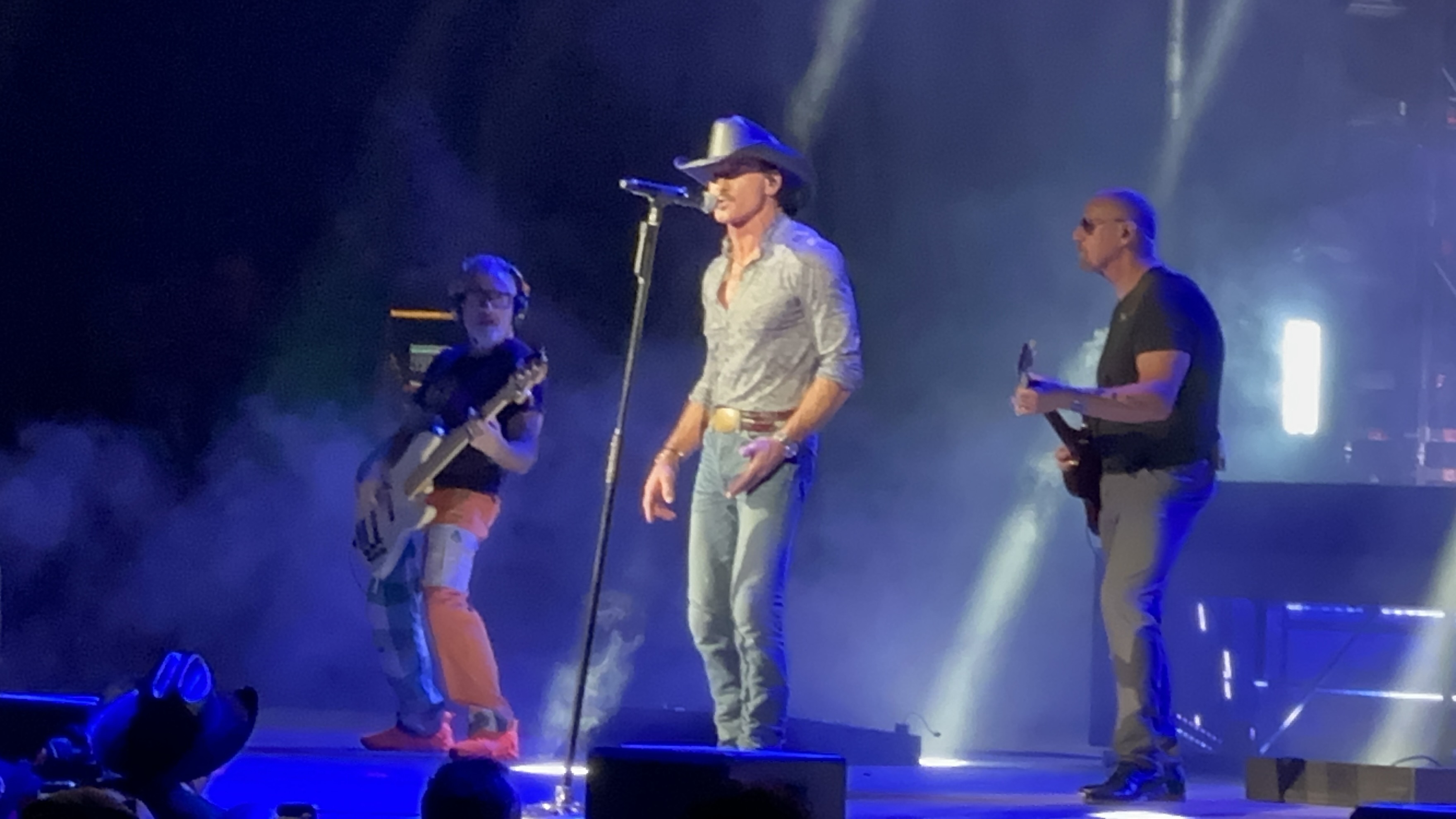
When the electric set kicked in, the show widened fast. “Real Good Man,” “Indian Outlaw,” and “Something Like That” turned the amphitheatre into a jukebox of late-’90s and early-2000s country swagger, but the shift did not feel abrupt so much as earned. After the acoustic first act, the bigger grooves arrived like the night opening its shoulders. The Dancehall Doctors tightened each song without sanding down its grit, locking into a muscular, road-tested sound that gave McGraw room to roam the stage and reconnect with the crowd at full scale. He checked in — “Are you having fun?” — with the ease of someone who already knew the answer, then explained the tour’s title. The story was classic country mythology with a wink: a freshman football dream surrendered to reality, a high school ring traded at a pawnshop, a $25 guitar, 50 songs learned over a summer, and a first gig played for tips. It gave the slickness of the production a rougher, more personal origin point.
That origin story gave “Pawn Shop Guitar” its weight. Rather than arrive as a branding exercise, it sounded like a miniature autobiography, a reminder that McGraw’s durability has always come from making big rooms feel connected to modest beginnings. The song’s appeal was less about romanticizing the past than honoring the first object that made a future imaginable. He extended that idea by signing and gifting a pawnshop guitar to two young fans, Vivian and Esme, after making them promise they would learn it. It was a small ceremony, but an effective one, because it did not require spectacle to make its point. Country music, at its best, has always been about inheritance: a melody passed down, a guitar handed over, a story retold until it belongs to more than one person. In that moment, McGraw made the tour title feel less like merchandise and more like a mission statement.
The back half leaned hard into release. “Southern Girl” led into a patriotic preface for “Song for America,” with McGraw acknowledging the country’s 250th anniversary and the messiness of the moment before landing on gratitude: “There’s no place that I’d rather live than right here in the United States of America.” He handled the moment with warmth and clarity, keeping the focus on belonging, gratitude, and shared experience. Then came the crowd-pleasers in quick succession — “I Like It, I Love It,” “Felt Good on My Lips,” “Mexicoma,” and “Live Like You Were Dying.” The sequence was a reminder of how easily McGraw can move across eras without losing momentum. “I Like It, I Love It” played like a communal reflex, “Felt Good on My Lips” brought a loose, barroom lift, and “Live Like You Were Dying” still carried the solemn force of a song that has become bigger than its chart history. During the latter stretch, a photo of Dolly Parton appeared on the video board; McGraw turned, knelt, and bowed toward her image, a graceful nod to country music’s larger family tree.
The encore began unusually, with McGraw seated and visibly grateful for the pause. “Thank God for this stool right now,” he said, before explaining that the setup let him finally see the people who had spent the night singing back at him. That small change in posture altered the mood. The performance briefly stopped being about momentum and became about perspective: an artist taking stock, not in a grand farewell sense, but with the humility of someone who knows the stage is never guaranteed. What followed was the evening’s emotional center: a frank reflection on country music, family, gratitude, and recovery. McGraw spoke about four back surgeries, double knee replacement, rehab, and a period when he was not sure he would make it back to the stage. “Everybody goes through shit in their life,” he said, not as a throwaway line but as the frame for “King Rodeo,” a newer song born from that darker stretch. The candor gave the encore a lived-in gravity, and the audience responded less like spectators than witnesses.
From there, “The Cowboy in Me” and “Humble and Kind” landed with the earned calm of songs that no longer need to prove their value. The former carried the weathered self-awareness of a man looking back at the impulses that shaped him; the latter, now firmly lodged in the modern country canon, became a quiet benediction. If some of the earlier hits were built for raised arms and full-throated nostalgia, “Humble and Kind” asked for something gentler, and McGraw gave it space. “Truck Yeah” closed the night on a blast of rowdy release, sending the crowd out with one final jolt after a show that had moved from acoustic confession to electric celebration and back again. McGraw’s parting message — “Take care of each other and see you down the road” — felt less like a stock farewell than a tidy summation of the evening’s values.
The Tinley Park date sat near the end of a tour itinerary that moved through major amphitheatres and featured 49 Winchester on select dates, but the lasting impression was not merely that McGraw still has the catalog to hold a crowd that size. It was how thoughtfully he shaped that catalog into a complete evening. The strongest choice was structural: by beginning quietly, widening the frame, then returning to something intimate and reflective, he made familiar songs feel like stops along a longer life story rather than items checked off a setlist. The musical arc was generous, dynamic, and deeply effective, proof that McGraw’s best songs still gain meaning when placed in conversation with one another. On the Pawn Shop Guitar Tour, he did not just revisit where he has been; he made the case that the songs still know how to travel, even through rain, memory, recovery, and time.
Latest Updates
- Music Video: Tyler Nance - "Somethin With You"
- Music Video: William Beckmann - "You Only Love To Break My Heart"
- Lyric Video: CJ Solar & the Old Souls - “Blame It On Me”
- Music Video: Jade Eagleson and Midland - "Coming Soon To A Honky Tonk Near You"
- Visualizer: Colin Lynch - "In Due Time"
- Music Video: The Band Loula - "Other People"
- Music Video: Ian Harrison - "30 or 21"
- Music Video: Greylan James & Gabriella Rose - "Water At A Wedding (her side)"
- Single Review: Nate Smith - “Break Up Like That”
- Single Review: The Creekers - “The Devil’s Not That Far”
- Single Review: Tyra Madison - “There’s The Bar”
- Single Review: Lainey Wilson - “Kinda Love It”
- Single Review: Jon Langston - “Hate Me”
- Single Review: Chris Janson - “FUN”
- Single Review: Chase Matthew - “Started From The Holler”
- Single Review: Baylee Lynn - “Happy That We Met”
- Single Review: Austin Snell - “Something’s Always Breaking”
- #throwbackthursday: Lauren Alaina - "Georgia Peaches"
- Single Review: Randy Rogers Band feat. Parker McCollum - "Tommy Jackson"
- Single Review: Max Alan - "Hundred Thousand Sunsets"